
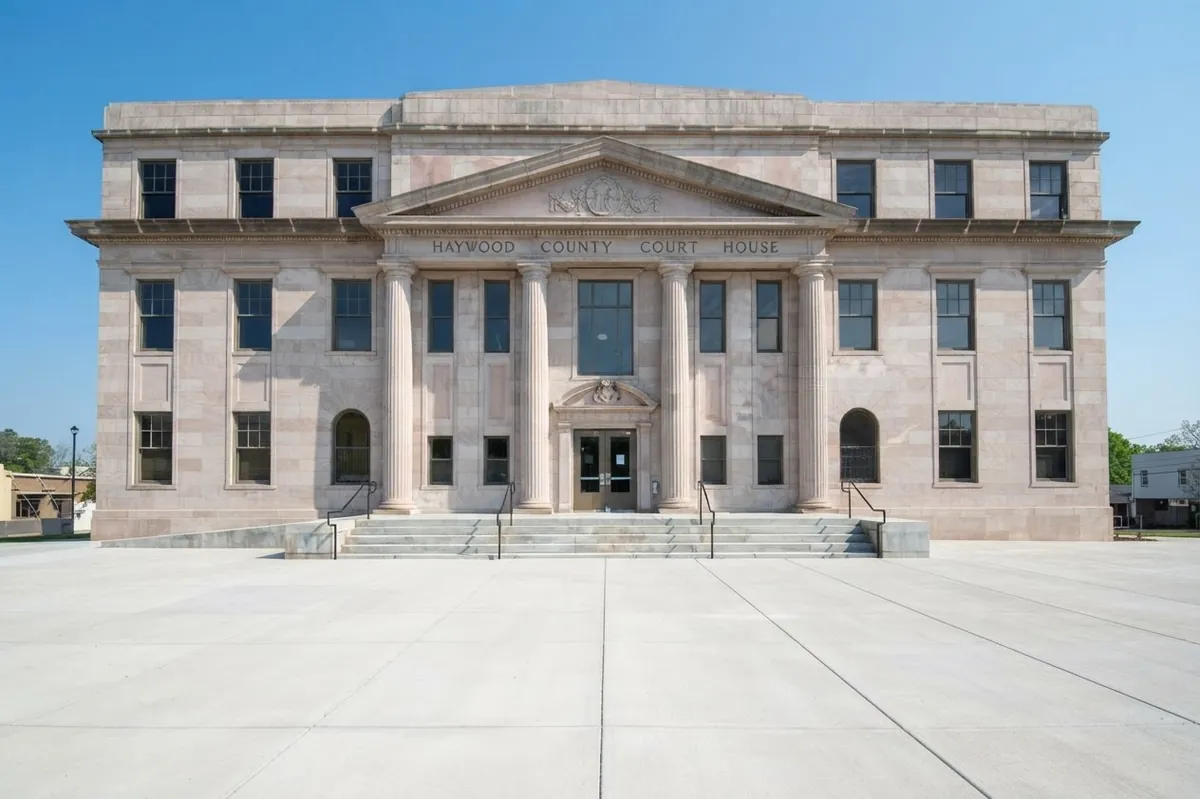
Court records in Haywood County, North Carolina, are maintained by the Clerk of Superior Court and can be accessed through online tools, official court portals, and the clerk's office. HaywoodCourt.us can help you find publicly available court record information for Haywood County. You can also search records through the North Carolina Judicial Branch's Haywood County page, visit the clerk's office in person, or use statewide public records portals to locate case details, court dates, and related documents.
Haywood Court System Overview
Haywood County is part of North Carolina's Judicial District 30, which serves Haywood County exclusively. The court system in Haywood County operates through both the Superior Court and District Court divisions, both housed at the Haywood County Justice Center in Waynesville. Superior Court handles felony criminal cases, major civil disputes, and appeals from District Court. District Court covers misdemeanors, infractions, small claims, family law matters, and juvenile cases. Magistrates serve under the District Court division, handling initial appearances, issuing warrants, performing marriages, and presiding over small claims cases.
Courts Serving Haywood
Several courts at the state and federal level serve Haywood County residents:
| Court | Address | Phone |
|---|---|---|
| Haywood County Superior Court | 285 N. Main Street, Waynesville, NC 28786 | (828) 454-6501 |
| Haywood County District Court | 285 N. Main Street, Waynesville, NC 28786 | (828) 454-6501 |
| Haywood County Magistrate's Office | 285 N. Main Street, Waynesville, NC 28786 | (828) 454-6501 |
| U.S. District Court, Western District of North Carolina (Asheville Division) | 100 Otis Street, Asheville, NC 28801 | (828) 771-7200 |
| U.S. Bankruptcy Court, Western District of North Carolina | 100 Otis Street, Asheville, NC 28801 | (828) 771-7300 |
Haywood County does not operate a separate municipal court. Traffic and ordinance violations within municipalities such as Waynesville, Canton, Clyde, and Maggie Valley are processed through the Haywood County District Court.
What Types of Cases Haywood Courts Hear
Courts in Haywood County handle a broad range of case types across criminal, civil, and specialized divisions:
- Criminal: Felonies, misdemeanors, infractions, DUI/DWI
- Civil: General civil litigation, small claims, summary ejectment (evictions)
- Family Law: Divorce, child custody, child support, domestic violence protective orders, paternity, termination of parental rights
- Probate and Estates: Decedent estates, guardianships, incompetency proceedings, trust matters
- Juvenile: Delinquency, undisciplined youth, abuse/neglect/dependency
- Traffic: Moving violations, license revocations
- Special Proceedings: Adoptions, name changes, foreclosures
The sections below explain which court division handles each type and how cases move through the system.
District Court Cases in Haywood
In North Carolina's court structure, District Court in Haywood County hears misdemeanor criminal cases, infractions, traffic matters, civil cases valued at $25,000 or less, small claims, and all family law and juvenile matters. District Court judges also preside over domestic violence protective order hearings and involuntary commitment proceedings. Cases typically begin when a complaint, citation, or petition is filed with the Clerk of Superior Court. A District Court judge is assigned, and the case proceeds through initial hearings, motions, and trial. Jury trials in District Court are not available for most case types — parties who want a jury trial in a misdemeanor case may appeal to Superior Court for a trial de novo.
Superior Court in Haywood County handles all felony criminal cases, civil cases exceeding $25,000, and appeals from District Court. Felony cases arrive in Superior Court after indictment by a grand jury. A Superior Court judge, who rotates through the district, presides over these cases.
Magistrate Court Cases in Haywood
Magistrates in Haywood County operate within the District Court division and handle several important functions:
- Small claims: Civil disputes up to $10,000
- Summary ejectment: Landlord-tenant eviction actions
- Criminal process: Issuing arrest warrants, search warrants, and criminal summonses
- Initial appearances: Setting bail and conditions of release for arrested individuals
- Worthless check cases: Accepting restitution and processing criminal complaints
- Marriages: Performing civil marriage ceremonies
Under North Carolina law (N.C.G.S. § 7A-210), small claims jurisdiction covers cases up to $10,000. Magistrates do not conduct jury trials. If either party in a small claims case is dissatisfied with the magistrate's decision, they may appeal to District Court for a new trial. Magistrate offices at the Haywood County Justice Center are generally available during regular business hours, and after-hours magistrate services are available for emergency matters such as warrants and domestic violence orders.
Family Law, Probate, and Juvenile Matters in Haywood
Family Law
Divorce, custody, child support, equitable distribution, paternity, and domestic violence protective orders are all heard in Haywood County District Court. North Carolina requires at least one year of separation before an absolute divorce can be granted. Divorce certificates can be obtained from the Clerk of Superior Court in Haywood County or through NC Vital Records. Custody and child support matters may be handled through mediation before going to trial.
Probate and Estates
The Clerk of Superior Court in Haywood County serves as the judge of probate. The clerk's office processes estate administrations, will probate, guardianship petitions, and incompetency proceedings. Trust disputes and contested estate matters may be transferred to Superior Court for resolution.
Juvenile
Juvenile cases — including delinquency, undisciplined conduct, and abuse/neglect/dependency — are heard in Haywood County District Court. Juvenile court records are confidential under North Carolina law and are not available to the general public. The Haywood County Guardian ad Litem program provides court-appointed advocates for children in abuse and neglect cases.
How Cases Move Through the Haywood Court System
- Filing / Initiation: A case begins when a criminal complaint, civil complaint, petition, or citation is filed with the Clerk of Superior Court. In criminal matters, law enforcement may also obtain warrants through a magistrate.
- Assignment: The clerk's office assigns the case a file number. Criminal cases are placed on the appropriate District or Superior Court calendar. Civil cases receive a scheduling order.
- Initial Hearing: Criminal defendants appear for a first appearance or arraignment. Civil parties attend a scheduling conference or respond to the complaint within the required timeframe (typically 30 days).
- Pre-Trial Phase: Parties exchange discovery, file motions, and may participate in mediation or plea negotiations. Family law cases often require mediation for custody disputes before trial.
- Trial or Resolution: Cases are resolved through plea agreement, bench trial, jury trial, settlement, consent order, or default judgment.
- Post-Judgment: In criminal cases, sentencing follows a conviction. Civil judgments may be enforced through garnishment, liens, or contempt proceedings. Either party may file an appeal — misdemeanor appeals go to Superior Court, and Superior Court appeals go to the North Carolina Court of Appeals.
Court Administration, Local Rules, and Public Access in Haywood
The Haywood County courts are administered by the Senior Resident Superior Court Judge and the Chief District Court Judge for District 30. A Trial Court Administrator coordinates day-to-day operations, scheduling, and staffing at the Justice Center. Contact the clerk's office at (828) 454-6501 for administrative inquiries.
Local rules for Judicial District 30 govern scheduling, motions practice, mediation requirements, and courtroom procedures. These rules are available through the North Carolina Judicial Branch website or by request from the clerk's office.
Public Access to Records
Under North Carolina's Public Records Act (N.C.G.S. Chapter 132) and court administrative rules, most court records are open to the public. You can view criminal case information at public self-service terminals located in the Haywood County Clerk of Superior Court's office. Some records are restricted, including:
- Juvenile case files
- Sealed or expunged records
- Adoption records
- Records in involuntary commitment proceedings
- Grand jury proceedings
To request a public record from the court, contact the clerk's office directly. Certified copies of court documents require a fee. Hearings are generally open to the public and can be attended in person at the Justice Center. Some proceedings may be conducted by remote audio or video at the court's discretion.
Court Records and Related Court Resources in Haywood
- Court record searches: The North Carolina Judicial Branch portal allows you to search court dates, case information, and make payments online for criminal, civil, and traffic cases statewide, including Haywood County.
- Obtaining court records: The Court Records help topic page explains how to access criminal and civil records, request background checks, and learn about expungement.
- Clerk of Superior Court: The Haywood County Clerk of Court at the Justice Center handles records requests, filing, and public access to case files.
- Offender and inmate search: The NC Department of Adult Correction offender search covers county jail inmates, state prisoners, probationers, parolees, and registered sex offenders.
- Online public records: The NC DAC public records page and the NC DPS links page provide access to various criminal justice records available online without a formal request.
- Vital records: Birth, death, and marriage certificates can be ordered through NC Vital Records or the Haywood County Register of Deeds. Divorce certificates are available from the clerk's office or NC Vital Records.
- Property and tax records: Haywood County GIS maps and the Haywood County tax bill search provide access to land records and property tax information.
- Haywood County court information: The Haywood County page on the NC Judicial Branch website lists courthouse contacts, court dates, jury service details, and local program information.
- Additional help: HaywoodCourt.us provides a starting resource for locating publicly available court record information in Haywood County.